
It’s December, 2025, and I’m a junior SEO specialist. This post marks my SEO baseline for every future accomplishment and milestone, all while building my portfolio and gaining experience.
Today already marks an important milestone: the first public deep-dive into my site’s performance, and introduction to the metrics I’ll be working to improve. I’m not doing last minute fixes right before posting, just giving an honest breakdown.
I want this post to be looked back upon in the future, so that clients, myself, and casual readers alike can see the humble beginning of my journey. I’ll openly include mistakes made and losses, just as much as wins.
My Starting Point
I’m an amateur in the SEO industry. I have zero authority, almost zero traffic, and only 2 indexed URLs. I’m not hiding this, nor should I.
Everyone starts somewhere, so I’ve been implementing core concepts I learned from Moz’s Beginner’s Guide to SEO (highly recommend for beginners like me!)
The First Signal
Even at this baseline, there’s movement. My first blog post, “From Design to SEO: Launching My Career Before Graduation” generated a bit of traffic.
While this is only a short term boost, it definitely confirms something important: my site is crawlable, indexable, and capable of driving engagement.
A lot of my traffic isn’t organic yet, but this is a reassuring sign:
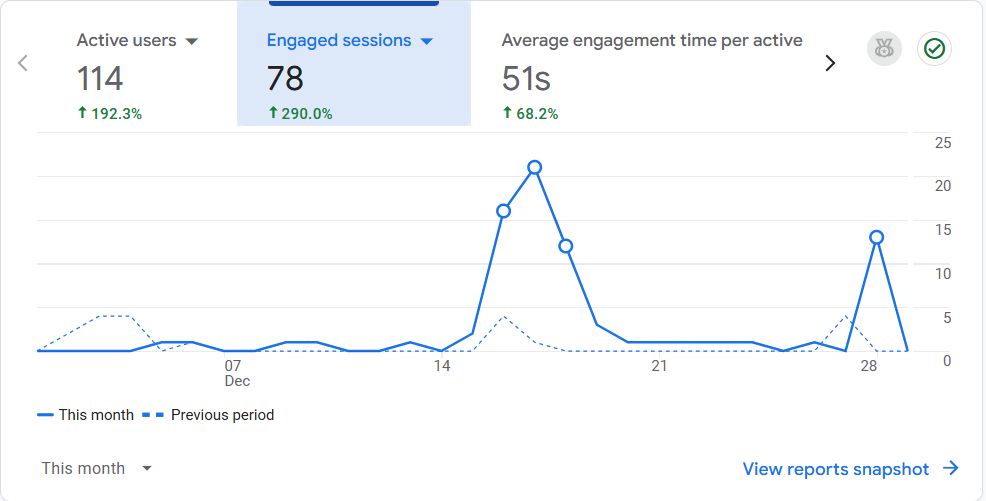
At this point, the sole focus isn’t growth; it’s having a stable, crawlable, and visible website. Traffic and rankings come later. I’m sticking to the basics that I learned from the Moz guide.
What I’m Measuring
For every site status update, I’ll be tracking the same core set of metrics. Although, I won’t be tracking engagement metrics just yet, due to the lack of engagement in this early stage:
Visibility Metrics
Indexing Status & Indexing Time
Current status: 2 out of 6 URLs indexed
My homepage and first blog post are my only indexed URLs. The blog post was indexed on the same day it was published (with a request on Google Search Console), so that’s an encouraging early signal.
This is definitely due to the content density and page optimization I simply haven’t put into the others. My homepage and first blog post are the most content-dense and valuable URLs on the site.
Going forward, I’ll be tracking:
- Which pages get indexed
- How long indexing takes after publishing
- Whether indexing behavior changes as site structure improve
Search Impressions
Current Status: Minimal & Inconsistent

At this stage, impressions are inconsistent and primarily due to branded queries (e.g., my only top searched queries are “seo carrizales” and “seo colby”). This traffic is led by friends and family who searched for me directly, it’s not people discovering me organically through industry related keywords.
This proves that the site is recognizable to Google, but not that it can compete with other sites when searching with non-branded queries. I just don’t have organic traffic yet.
As the site grows, this metric will become more meaningful when impressions start coming from searches related to SEO services and not me personally.
Average Position
Current Status: No meaningful data yet
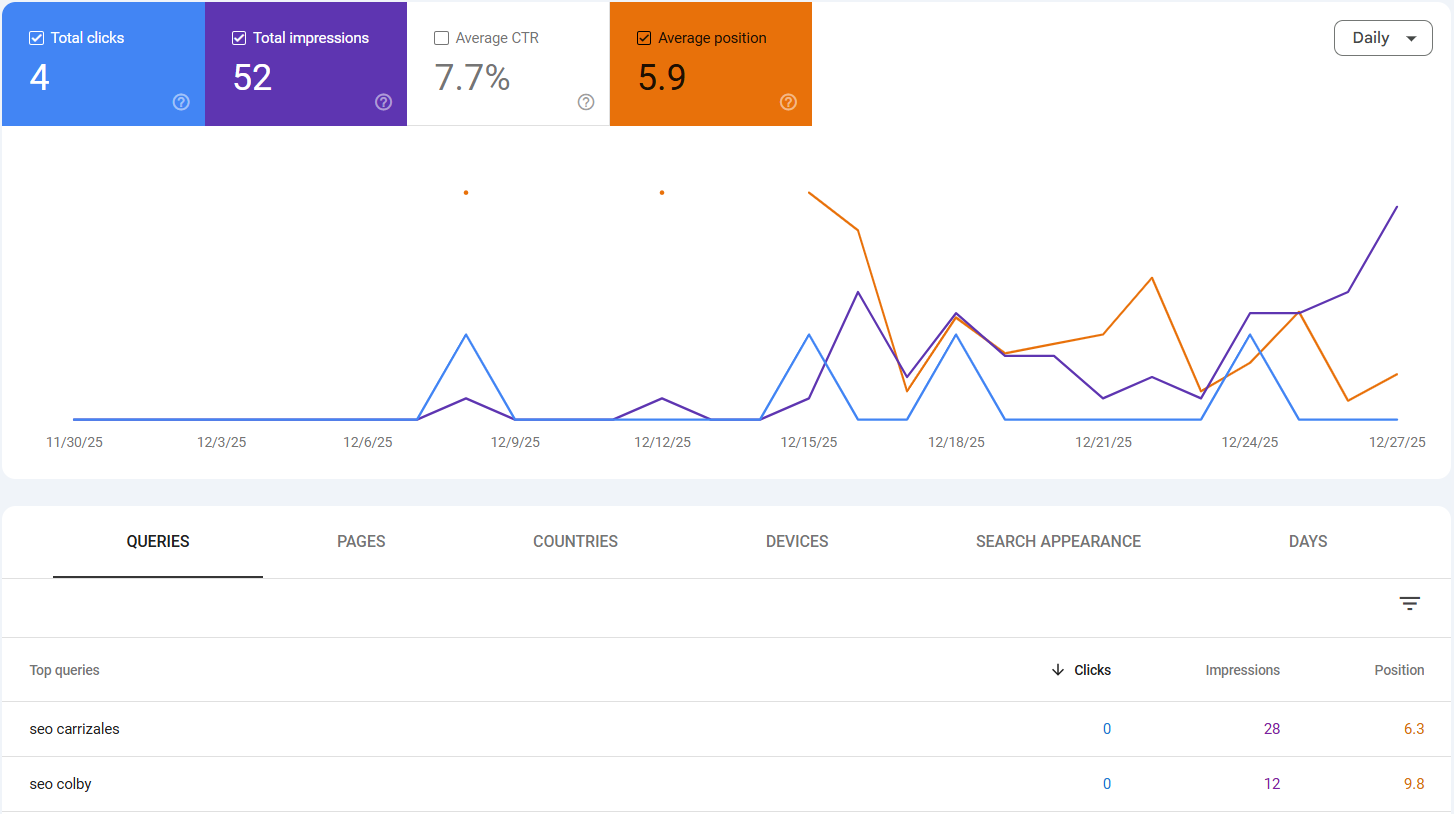
As I said, I don’t have any organic search traffic from non-branded queries. Because of this, average position (orange) isn’t a useful metric right now.
I’m still acknowledging this metric today, because this is one of those times where the absence of data is the data. This will be most likely be the case for the next few site status updates as well.
As soon as non-branded queries start showing up, average position will be a useful way to track if visibility is improving over time.
Technical Health Metrics
Let’s separate ourselves from the performance side of things for a second. I need to make sure I’m starting with an accessible website. A site that’s understandable for both Google and the people actually experiencing it.
Here, I’ll determine whether Google can reliably crawl my site, how the pages are organized, and review any technical issues that may limit future growth.
Site Structure
Current Status: Simple, intentional, and minimal
At this stage, the site isn’t complex, and provides what I believe to be a smooth experience for viewers. The site structure is minimal, because I want to focus on clarity and follow a quality-over-quantity approach. I won’t add pages on a whim that aren’t properly set up and implemented responsibly.
Most of my URLs are clean and readable. Although, I don’t currently have a clear distinction of core pages and blog content on my slugs (such as using a dedicated “/blog/” path). For now, I’m keeping things simple while I learn how structure affects Google’s crawls.
Internal linking is intentional and doesn’t seem to have any underlying issues. Pages are linking to each other when relevant.
Currently, there is little technical optimization for my pages (besides the first blog post, the blog page, and some of the homepage). Even some smaller things like title tags and meta descriptions have yet to be looked at, but my goal is to come back with some of these issues resolved in the next status update.
404 Monitoring (Early Observation)
While looking over basic site health on my WordPress dashboard, I noticed a growing number of 404 errors being logged. At first, this was confusing and slightly worrisome, since I was confident that there weren’t any core page linking issues.
Now, I’ve seen that these 404s seem to be requests for WordPress admin files, instead of real pages on the site. I haven’t created these URLs, and they’re not pages that people would search for or find in my site’s navigation.
I don’t fully understand why these requests happen yet, but for now, it seems to be automated bot activity, rather than real users running into broken pages. Because of that, this is merely an observation, and is something I plan to revisit once I learn more about why this is happening.
Mobile & Performance Baseline
Current Status: Functional, with room to improve
At this point, the site is usable on mobile and doesn’t show any obvious issues that would prevent users from reading content or navigating pages.
Performance hasn’t been a focus yet. I haven’t spent time optimizing page speed or going into performance metrics. There are likely small tweaks that should be made later on. For now, the goal is to make sure there aren’t any broken pages, links, or anything else that might hurt the user experience.
This section exists to act as a reference point. As the site improves and performance becomes more relevant, I’ll return here with insight and data.
What I’m Not Measuring (Yet)
There’s a lot of metrics that I’m not tracking. This isn’t because they’re not important, but because they wouldn’t be useful indicators of progress right now. I’m not focusing on engagement metrics, or things like backlinks or domain authority, until they’re relevant.
For now, I’m building a strong foundation, instead of chasing specific outcomes. As the site begins to show real signs of organic discovery, these metrics will be useful and easier to interpret. Then, they’ll naturally become a part of future updates.
What Comes Next
This is my SEO baseline. Everything documented here is meant to stay exactly as it is. This is a reference point, not something I’ll revise later.
From here, I’ll be posting new updates when meaningful changes happen, whether that’s on-page fixes, indexing behavior, technical health, or eventually when I get organic visibility. Each update will tie back to this post, showing where everything started. Before the site gets consistent traffic, and is in tip-top technical shape!
Thank you for reading this blog post, and I hope you stick with me during this journey. Feel free to ask me a question in the comments or reach out to me directly on my contact page. As I’m writing this, it’s only a few days until the new year. So, I’ll see you in 2026!

Leave a Reply